
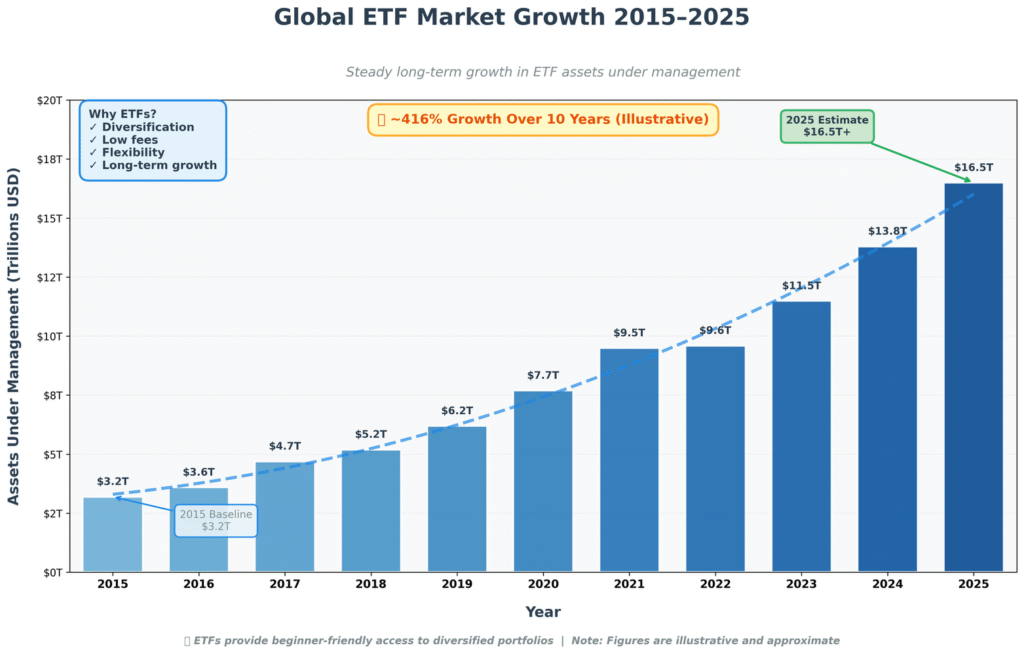
If you’ve ever wondered how to invest in the stock market without picking individual companies or learning complex strategies, then ETFs (Exchange-Traded Funds) are your new best friend. ETFs are widely considered the easiest, most beginner-friendly method to invest in stocks because they provide diversification, low fees, flexibility, and long-term growth potential, all in one package.
Whether your goal is retirement savings, building passive income, or simply starting your investment journey, this guide will walk you step-by-step through understanding ETFs and how to use them to build wealth.
In this full beginner blueprint, you’ll learn:
- What ETFs are and how they work
- The different types of ETFs and their benefits
- How to buy your first ETF
- ETF vs mutual fund breakdown
- Key risks + how to avoid mistakes
- Beginner portfolio examples
- FAQs
You’ll also see visual placeholders, step-by-step actions, examples, and key terms to help you feel confident investing.
What Exactly Is an ETF?
An ETF (Exchange-Traded Fund) is a bundle of assets packaged into a single investment that trades like a stock.
Inside an ETF, you’ll find many investments, such as stocks, bonds, or commodities, all grouped together. This gives you instant diversification and reduces the risk associated with owning only one or two companies.
Instead of researching and buying individual stocks, you can buy just one ETF and instantly own hundreds or thousands of companies from different industries. This bundled structure makes ETFs one of the easiest ways to invest while maintaining a balanced portfolio.
How ETFs Work
Most ETFs are designed to track an index. An index is a collection of companies grouped together based on certain characteristics (size, industry, country, etc.).
For example, an ETF that tracks the S&P 500 aims to match the performance of the 500 largest U.S. companies.
If the market goes up, your ETF investment typically goes up. If the market goes down, your ETF will usually follow. Because most ETFs are passively managed (they try to mirror an index instead of picking winners), they have significantly lower fees, making them a favorite among experts.
Real-World Example
Let’s say you want exposure to the biggest companies in the U.S., Apple, Microsoft, Amazon, Tesla, Meta, and others. instead of buying each individually (which would cost thousands), you can buy just one share of an S&P 500 ETF. That single share gives you tiny slices of all 500 companies at once.
Key takeaway: One ETF purchase instantly gives you exposure to a wide range of companies, reducing risk.
Why ETFs Are Ideal for Beginners
If you’re new to investing, ETFs should be your top priority.
They combine simplicity, affordability, and strong historical performance.
Even professional investors consider ETFs a core building block of their portfolios.
1. Low Cost
The fee that ETF companies charge is called an expense ratio. Most ETFs charge between 0.03% and 0.20% annually just a few dollars per year on a $10,000 investment. Lower fees mean more of your money stays invested, helping it grow over time.
Comparatively, mutual funds can charge 1%–2% per year. That might not seem like much, but over 20–30 years, the difference can cost you tens of thousands of dollars.
2. Diversification Reduces Risk
Investing in individual stocks means your entire investment depends on a company’s performance. If that company fails, you could lose big.
With ETFs, your money is spread across many companies. If one company performs poorly, others can balance out the losses.
3. Easy to Buy and Sell
ETFs trade like regular stocks. You can buy and sell them during market hours through a brokerage app. This flexibility makes ETFs attractive to all types of investors.
Since ETFs have no minimum investment beyond share price,
you can start with very little capital even €1–€10 with fractional shares.
4. Transparent Structure
ETFs publish their holdings daily. You always know exactly what is inside your investment, helping you make informed decisions.
5. Great for Long-Term Wealth Building
Historical data shows that broad-market ETFs especially those tracking the S&P 500 have delivered strong returns
averaging 8–10% per year over long periods.
This makes ETFs ideal for:
- Retirement investing
- Education funds
- Long-term saving
Types of ETFs
There are thousands of ETFs available, each with a different strategy and asset focus.
Understanding the main categories helps investors tailor portfolios to specific goals.
1. Index ETFs
Index ETFs track popular market indexes:
- S&P 500
- NASDAQ 100
- Dow Jones
- MSCI World
These are ideal for beginners because they offer broad exposure and low fees.
2. Bond ETFs
Bond ETFs provide diversification and stability.
They invest in government, corporate, and municipal bonds, making them great for:
- Lower risk tolerance
- Retirement planning
- Market volatility hedging
3. Sector ETFs
If you want exposure to specific industries, sector ETFs are your tool.
Examples include:
- Technology
- Healthcare
- Energy
- Financial
These can provide higher returns but carry more concentrated risk.
4. Dividend ETFs
Dividend ETFs invest in companies that regularly pay dividends. These funds provide passive income and growth, perfect for:
- Income investors
- Retirees
- Wealth builders
How to Buy Your First ETF
Buying an ETF is extremely simple if you’ve ever bought something online, you can buy an ETF.
Here’s a quick step-by-step guide.
Step-by-Step Buying Process
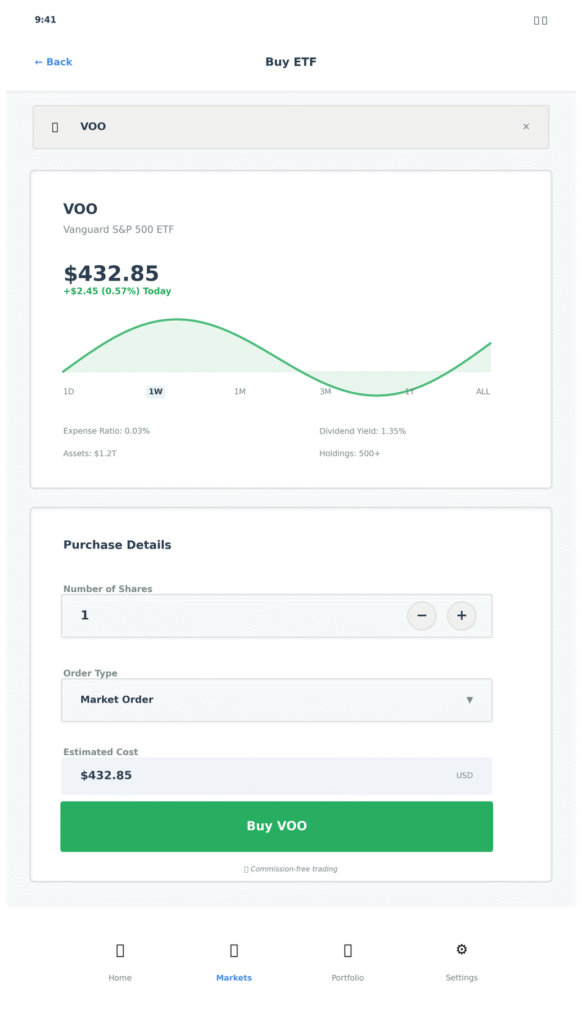
- Open a brokerage account.
- Deposit funds.
- Search for your chosen ETF ticker (e.g., VOO, SPY, QQQ).
- Choose how many shares you want.
- Click Buy.
ETFs vs Mutual Funds
Mutual funds and ETFs both provide diversification, but ETFs have some major advantages.
| Feature | ETF | Mutual Fund |
|---|---|---|
| Trade Anytime | Yes | No (End-of-day only) |
| Minimum Investment | Low | Often €500–€3,000 |
| Fees | Low | Higher |
| Transparency | High | Lower |
| Tax Efficiency | Higher | Lower |
Because of these benefits, many investors now prefer ETFs to mutual funds for long-term wealth.
Beginner ETF Portfolio Examples
Here are three simple ETF portfolios, depending on your risk tolerance.
Conservative
- 40% S&P 500 ETF
- 40% Bond ETF
- 20% International ETF
Balanced
- 60% S&P 500 ETF
- 20% International ETF
- 20% Bond ETF
Growth
- 70% S&P 500 ETF
- 20% Tech ETF
- 10% International ETF
You can adjust these allocations depending on your age, goals, and risk tolerance.
Common ETF Mistakes to Avoid
- Buying too many ETFs with overlapping holdings
- Chasing short-term performance
- Ignoring expense ratios
- Not diversifying beyond one sector
These mistakes can dilute performance or increase risk unnecessarily.
Frequently Asked Questions
1) Can I lose money with ETFs?
Yes. ETFs move with the market. If the market falls, ETF values can decline.
However, diversification helps cushion losses.
2) How much do I need to start?
You can start with as little as the cost of one share or even €1 with fractional investing. Consistency matters more than amount.
3) Are ETFs safe for long-term investing?
Yes. Broad-market ETFs are considered among the safest long-term investment vehicles.
Conclusion and Final Call to Action
ETFs are the simplest, safest, and most affordable way to start investing.
They provide diversification, low fees, transparency, and strong long-term returns.
Whether you’re a beginner or experienced investor, ETFs can help you build a long-term portfolio that grows steadily over time.