Diversification is one of the cornerstones of successful investing, it’s how smart investors protect their wealth, reduce risk, and achieve consistent long-term returns. But if you’re a beginner, “building a diversified portfolio” might sound like something only professionals or millionaires do. The good news? You don’t need a finance degree or a fortune to get started. With the right strategy and tools, anyone can build a diversified investment portfolio that grows steadily over time while minimizing risk.
In this comprehensive guide, we’ll walk you through how to build a diversified portfolio from scratch. You’ll learn what diversification really means, how to assess your risk tolerance, which assets to include, and how to manage and rebalance your portfolio like a pro. By the end, you’ll have a clear, actionable plan to grow your wealth confidently, even if you’re starting small.
What Diversification Is and Why It Matters More Than You Think
Diversification simply means spreading your money across different types of investments so that no single asset has too much control over your financial success. The concept is based on one of the oldest and most reliable investing principles: “Don’t put all your eggs in one basket.”
When one investment underperforms, for example tech stocks dropping during a market correction, other assets like bonds or real estate may remain stable or even increase in value. This balance helps smooth out your overall returns and protects your portfolio from major losses.
The Science Behind Diversification
Numerous studies, including research from https://investor.vanguard.com/corporate-portal, have shown that diversification can reduce volatility and improve risk-adjusted returns. For instance, during the 2008 financial crisis, investors with 100% stock portfolios saw their investments drop over 50%, while those with diversified portfolios (including bonds and real estate) often lost less than half that amount, and recovered faster.
In short, diversification doesn’t guarantee profits, but it significantly reduces the chance of catastrophic losses. It helps you stay in the market longer which is one of the biggest predictors of investing success.
Step 1. Define Your Risk Tolerance
Before you invest a single dollar, you need to understand your risk tolerance, how much uncertainty you can handle without panicking or selling at the wrong time. Risk tolerance depends on several factors: your age, financial goals, income stability, and emotional comfort with market fluctuations.
1. Assess Your Personal Situation
- Age: Younger investors have more time to recover from downturns and can take more risk (more stocks, fewer bonds).
- Financial goals: Long-term goals (like retirement) can handle more volatility than short-term goals (like buying a home).
- Income and job security: Stable income allows for more aggressive investing.
- Personality: If market drops cause you sleepless nights, you may prefer a more conservative portfolio.
2. Risk Categories (Simplified)
- Conservative: 20% stocks, 70% bonds, 10% real estate
- Balanced: 50% stocks, 40% bonds, 10% real estate
- Growth-oriented: 70% stocks, 20% bonds, 10% real estate
- Aggressive: 90% stocks, 10% bonds
3. Use Risk Profiling Tools
Use an online risk tolerance calculator or investing app to determine your comfort level. Many platforms include free assessments and build custom portfolios based on your profile.
Step 2. Choose Your Core Asset Classes
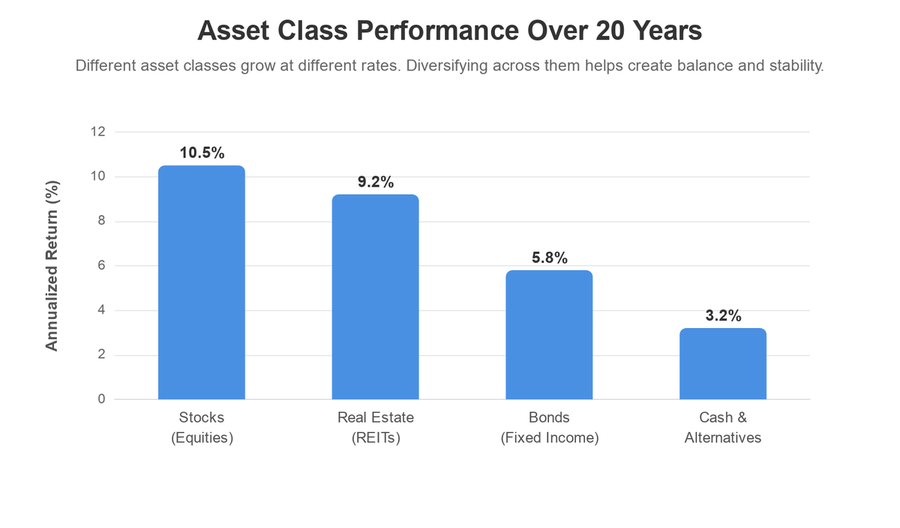
Once you understand your risk tolerance, the next step is to decide which asset classes to include in your portfolio. Each asset type behaves differently, so combining them can create balance and stability.
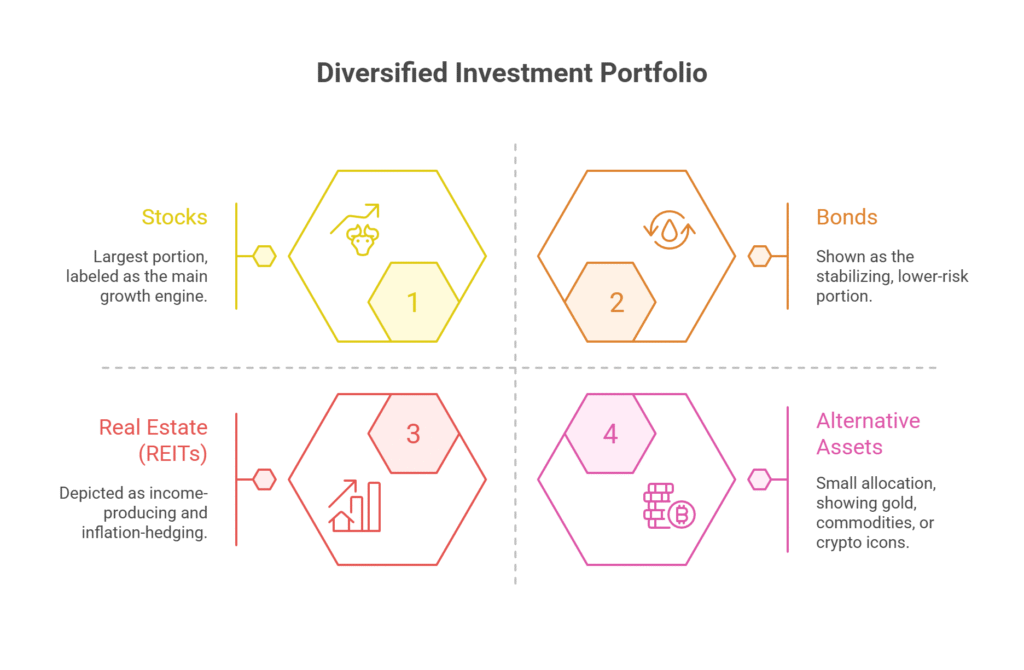
1. Stocks (Equities)
Stocks represent ownership in a company and are the main driver of long-term growth. They can be volatile in the short term but historically deliver higher returns than other asset types.
For beginners, focus on diversified funds such as S&P 500 index funds or total stock market ETFs. These spread your investment across hundreds or thousands of companies automatically.
2. Bonds (Fixed Income)
Bonds are loans to governments or corporations that pay you interest over time. They act as a stabilizer when markets get rocky. The general rule: as you age, increase your bond allocation to reduce volatility.
3. Real Estate
Real estate investments, whether direct property ownership or REITs (Real Estate Investment Trusts), add inflation protection and a potential source of steady income. REITs are an easy way to get exposure without managing property yourself.
4. Cash and Alternatives
Cash and alternative assets (like gold, crypto, or commodities) can hedge against market downturns. While they typically yield lower returns, they offer liquidity and flexibility.
Step 3. Diversify Within Each Asset Class
True diversification means going beyond owning just one stock fund or bond. You need to spread your investments within each category for maximum protection and growth potential.
Diversifying Your Stock Portfolio
- By geography: Invest in both U.S. and international markets (for example, 60% U.S., 40% international).
- By company size: Mix large-cap, mid-cap, and small-cap stocks to capture different growth dynamics.
- By industry: Avoid concentrating in one sector (e.g., tech or healthcare). Broad ETFs solve this easily.
Diversifying Bonds
- Include both government bonds (safe but low yield) and corporate bonds (higher yield but riskier).
- Mix short-term and long-term bonds to balance returns and interest rate risk.
Diversifying Real Estate
Not all real estate performs the same. Consider mixing residential, commercial, and industrial properties through REITs or ETFs focused on specific niches like data centers or logistics.
Tip:
Look for “all-in-one” ETFs that include multiple asset classes, like balanced or target-date funds. They automatically rebalance your portfolio based on your time horizon.
Step 4. Keep Costs Low (They Matter More Than You Think)
Investment costs, including management fees, trading commissions, and expense ratios, directly reduce your returns. A seemingly tiny 1% annual fee can cost you tens of thousands over a few decades.
Example: The Impact of Fees
If you invest $100,000 for 30 years at a 7% return:
- With 1% annual fees, you’ll end up with about $574,000.
- With 0.1% fees (typical of low-cost ETFs), you’ll have roughly $740,000.
That’s a difference of $166,000, just from lower fees!
How to Minimize Costs
- Use low-cost index funds or ETFs with expense ratios below 0.2%.
- Avoid frequent trading and emotional buying/selling.
- Watch out for hidden fund fees and advisory costs.
- Consider automated investing platforms like [affiliate:LowFeeBroker] for hands-free, low-cost diversification.
Step 5. Rebalance Your Portfolio Regularly
Over time, some assets will grow faster than others, causing your portfolio to drift from its original allocation. Rebalancing means adjusting your investments back to your target percentages by selling overperforming assets and buying underperforming ones.
Why Rebalancing Matters
Without rebalancing, your portfolio can become riskier than intended. For instance, after a stock market rally, your 60/40 (stocks/bonds) portfolio could shift to 70/30, exposing you to higher volatility.
How to Rebalance
- Review your portfolio once or twice a year.
- Compare your actual allocations with your target ones.
- Sell a portion of assets that are overweight and buy those that are underweight.
Some brokers and robo-advisors automate this process for you a major time-saver for beginners.
Step 6. Stay Consistent and Avoid Market Timing
The biggest investing mistake beginners make is trying to predict market highs and lows. Even professional investors rarely get it right. Instead, focus on time in the market not timing the market.
Adopt a Long-Term Mindset
Markets naturally fluctuate, but long-term trends show consistent growth. A $10,000 investment in the S&P 500 in 1990 would be worth over $200,000 today, despite multiple recessions along the way.
Practical Strategy
- Use dollar-cost averaging (DCA): invest a fixed amount regularly, regardless of market conditions.
- Automate contributions to remove emotions from the process.
- Stay diversified and resist panic selling during downturns.
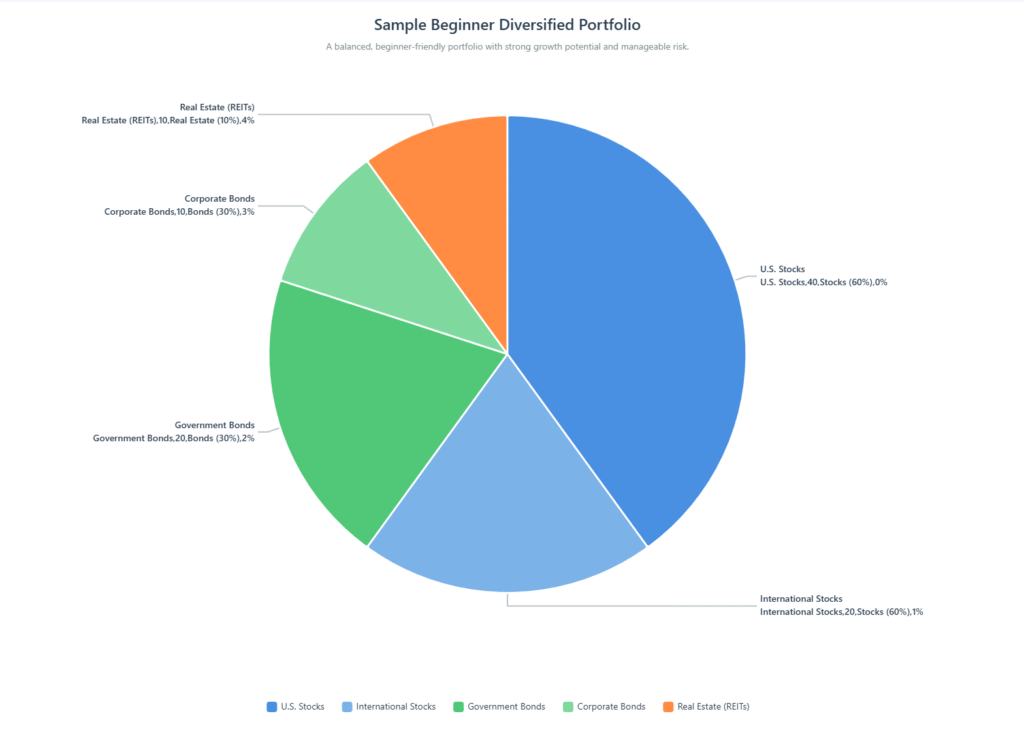
Example Beginner Portfolio (Balanced Model)
60% Stocks (40% U.S., 20% International)
30% Bonds (20% Government, 10% Corporate)
10% Real Estate (via REITs)
This simple model offers strong growth potential while maintaining balance. You can adjust the ratios based on your age, risk tolerance, and goals.
Common Mistakes to Avoid When Building a Portfolio
- Overdiversification: Owning too many similar funds can dilute returns without reducing risk.
- Ignoring fees: Always check expense ratios and trading costs.
- Emotional investing: Don’t sell in panic or chase hot trends.
- Neglecting rebalancing: Letting allocations drift can lead to unintended risk exposure.
Staying disciplined is more powerful than chasing quick gains. Successful investing is about strategy, not luck.
Final Thoughts on Building a Diversified and Resilient Portfolio
Building a diversified portfolio as a beginner doesn’t have to be complicated. Start small, focus on your long-term goals, and invest consistently. By combining different assets, keeping costs low, and rebalancing regularly, you’ll protect yourself from volatility and set the stage for sustainable wealth growth.
Remember: investing isn’t about perfection; it’s about consistency and discipline. The earlier you start, the more time your money has to compound and work for you.
Take Action Today: Define your goals, open an investment account, and start with a simple diversified ETF or index fund portfolio. The best time to start was yesterday. The second-best time is now.
Frequently Asked Questions
1. How much money do I need to build a diversified portfolio?
You can start with as little as $50–$100. Thanks to fractional shares, you can own parts of ETFs or stocks, making diversification accessible to everyone.
2. How often should I rebalance my portfolio?
Once or twice a year is ideal. Rebalancing too often may lead to unnecessary fees, while ignoring it can increase risk exposure.
3. What’s the easiest way to diversify as a beginner?
Start with a target-date fund or an all-in-one ETF that automatically diversifies across asset classes and rebalances for you.
4. Should I invest in international stocks?
Yes. Global diversification spreads risk across economies. U.S. markets dominate, but exposure to Europe, Asia, and emerging markets adds long-term balance.
5. Is real estate necessary in a diversified portfolio?
Not required, but recommended. Real estate and REITs often move independently of stocks, improving overall stability and providing income through dividends.